
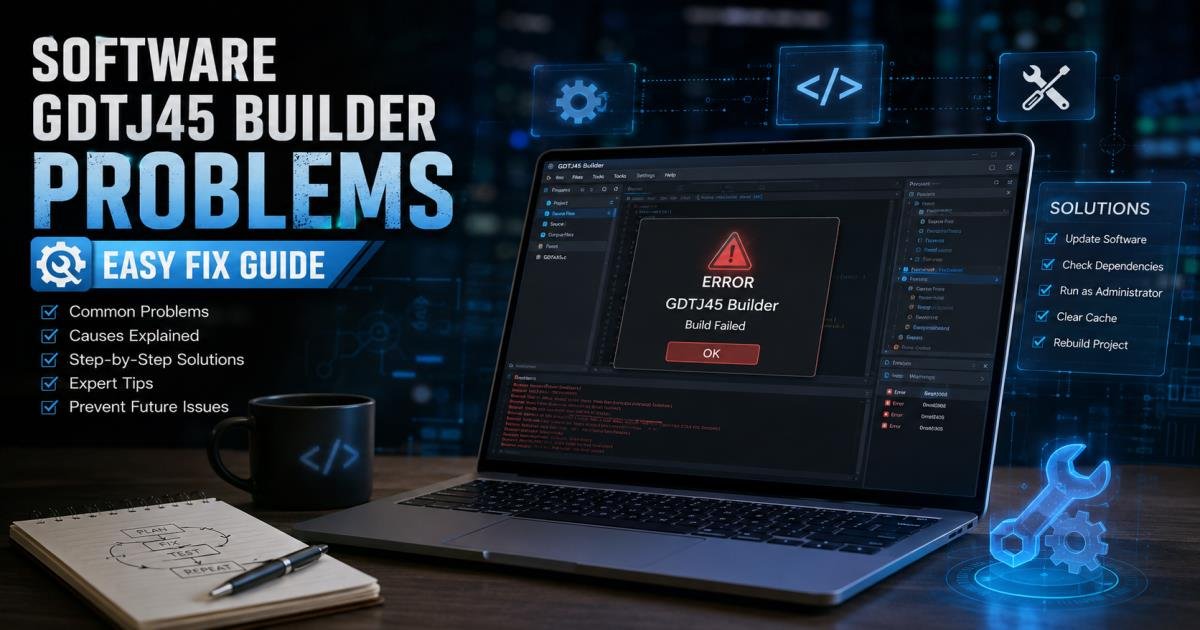

Software GDTJ45 builder problems usually stem from corrupted setup files, missing system packages, outdated runtime tools, security software interference, or low RAM during project compilation. You can resolve most of these glitches by running the application as an administrator, clearing temporary cache files, restoring missing dependencies, or performing a clean installation.
When your build tool stops responding or throws unexpected exceptions, it halts your entire project pipeline. This guide walks you through every common error, explains why it happens, and provides clear steps to fix it.
What is Software GDTJ45 Builder?
Overview of the Software
Software GDTJ45 Builder is a hybrid application editor that combines visual drag-and-drop workspace tools with custom code editing. It gives you a central workspace to build reusable logic blocks, streamline project setups, and run scripts across desktop and web environments.
By offering automated syntax checks, code highlighting for popular programming languages, and multi-user sync tools, it speeds up prototype development and internal app building.
Common Use Cases
- Rapid Prototyping: Building Minimum Viable Products (MVPs) by connecting preset visual modules.
- Internal Tools: Constructing admin panels, database viewers, and management dashboards without writing boilerplate code from scratch.
- Script Management: Storing, organizing, and running frequently used code snippets and API connections across projects.
- Team Collaboration: Allowing design and engineering teams to work in a shared workspace without code conflicts.
Who Typically Uses It?
- Software Engineers & Web Developers: Looking to automate repetitive tasks and organize custom script libraries.
- Startup Founders: Building quick app prototypes to test business ideas with minimal development costs.
- Digital Agencies: Managing client projects that require standard app architecture and quick deployment pipelines.
- Systems Administrators: Building automated internal workflows and connecting APIs across business software.
GDTJ45 Builder Software Overview
To understand why bugs occur, it helps to look at how the software works. The platform connects visual interface components directly to custom code files, such as JavaScript, Python, or Java.
| Feature Area | Function | Primary Role |
| Workspace Canvas | Drag-and-drop interface | Connects visual components and logic flows |
| Code Editor | Embedded text editor | Handles custom module edits with auto-save support |
| Compiler & Debugger | Core checking engine | Scans syntax, verifies dependencies, and executes logic |
| Sync Engine | Real-time multi-user syncing | Tracks edits, records timestamps, and fixes workspace conflicts |
Because the software bridges visual elements with underlying code files, any break in the chain, such as a missing library file or an interrupted network request, triggers a software GDTJ45 builder problem.
What Are the Most Common Software GDTJ45 Builder Problems?
Installation Failures
Setup errors happen when the installer freezes midway, displays generic error codes like “Error 1603,” or fails to write folders to your hard drive. Restricted folder permissions or active antivirus scanners blocking background scripts usually cause these failures.
Startup or Launch Errors
When opening the builder, the launch screen may freeze, show a blank box, or throw a “Main Process Terminated” message. Launch errors mean that core configuration files or required system runtimes failed to load during boot.
Frequent Crashes or Freezing
System crashes often happen when you drag a heavy visual component onto the canvas or run a complex script. Freezing makes the app unresponsive, which can erase unsaved workspace changes if the auto-save cycle gets cut off.
Slow Performance
As projects grow to include hundreds of visual nodes and large custom scripts, interface lag increases. Scrolling through the workspace slows down, typing in the code editor delayed, and rendering visual canvases takes much longer.
Build or Compilation Errors
When you select “Run” or “Build Project,” the internal engine checks your code syntax. Missing brackets, unclosed lines, or broken API connections cause compilation to fail, blocking final project output.
Missing Dependencies
Modern low-code tools depend on external software runtimes like Node.js, Python packages, or .NET frameworks. If a required package is missing or installed in the wrong folder, the software displays “Module Not Found” messages.
Permission and Access Issues
If the app lacks system administrator rights to write to protected directories like C:\Program Files, it cannot save temporary cache files, build logs, or custom preferences.
Compatibility Problems After Updates
Updating either the application or your computer’s operating system can introduce unexpected software bugs. Features that worked smoothly on a previous version may show deprecation warnings or fail after a major update.
Why Do Software GDTJ45 Builder Problems Happen?
[System Event / Trigger]
│
├──> Outdated Software / OS ──────> Compatibility Failures
├──> Corrupted Installation ──────> Missing Core DLLs / Files
├──> Low System RAM / CPU ────────> Interface Freezes & Crashes
└──> Third-Party Blocking ────────> Blocked Ports & Script Errors
Identifying the root cause significantly speeds up the troubleshooting process.
Outdated Software Version
Using an older release means missing critical bug fixes, memory management updates, and current API integrations. Legacy versions struggle to run smoothly on modern operating systems.
Corrupted Installation Files
Sudden power outages, unexpected computer shutdowns, or dropped internet connections during an update corrupt core program files. When the application tries to open a damaged file, it crashes.
Operating System Compatibility
Major OS updates regularly update security settings, graphics rendering tools, and folder permissions. If the builder isn’t updated to match these OS updates, conflicts occur.
Insufficient System Resources
Running complex visual builders alongside web browsers, databases, and chat apps consumes available RAM and CPU power. On average, when system RAM usage exceeds 85%, application response times drop sharply, and UI lockups occur.
Incorrect Configuration Settings
Custom settings, such as bad folder paths, proxy errors, or wrong build directories, break project compilation. A single typo in a configuration file can prevent your project from running.
Third-Party Software Conflicts
Antivirus programs and firewalls frequently flag background developer tools as security risks. They can quarantine essential runtime files or block network connections required for team synchronization.
What Real Tools Do Similar Work?
If you are evaluating established tools that manage visual workflows alongside custom code, these platforms offer similar functionality:
- Retool: Connects directly to databases and APIs using visual components and custom JavaScript.
- Appsmith: An open-source tool for building internal software using pre-built UI widgets and custom JavaScript.
- FlutterFlow: A visual application builder for mobile and web software that lets developers export raw source code.
- OutSystems: An enterprise application builder designed for rapid software development and structured deployment.
How to Fix Software GDTJ45 Builder Problems
Follow these steps to fix performance and setup errors on your system.
Verify System Requirements
Before changing deeper settings, make sure your computer meets the minimum hardware specifications required to run the software:
- OS: Windows 10/11 (64-bit), macOS 12+, or modern Linux.
- Processor: Quad-core Intel i5 / AMD Ryzen 5 or faster.
- RAM: Minimum 8 GB (16 GB recommended for large projects).
- Storage: 5 GB free SSD space for program files and temporary cache.
- Network: Stable internet connection for team collaboration.
Reinstall the Software Properly
Installing over an existing installation often leaves corrupted cache files untouched. Follow these steps for a clean reinstall:
- Uninstall GDTJ45 Builder from your OS application menu.
- Delete leftover folders in %AppData%\GDTJ45 and %LocalAppData%\GDTJ45.
- Restart your computer.
- Download the latest setup file from the official source and run it.
Update to the Latest Version
Open the application, navigate to Help > Check for Updates, and install available patches. Updates fix memory leaks, resolve known bugs, and maintain system compatibility.
Install Missing Dependencies
Make sure your system has all necessary background packages:
- Install the latest Microsoft Visual C++ Redistributable package.
- Update your Node.js and Python runtimes if you run custom script modules.
- Confirm that .NET Framework 4.8 or higher is active on Windows.
Run as Administrator
Restricted account permissions prevent the application from writing local files. Right-click the desktop shortcut, select Run as Administrator, and test if the startup or file-saving errors disappear.
Check Security Software Interference
Temporarily turn off third-party antivirus software or add an exception for the GDTJ45 Builder application folder. Make sure your firewall allows traffic on local ports used for app previews and live syncing.
Repair Corrupted Files
Use the app’s built-in file checking tool if available under Settings > Maintenance > Verify File Integrity. You can also run a Windows system check (sfc /scannow in Command Prompt) to repair damaged OS dependencies.
Reset Configuration Settings
If customized settings broke your workspace, reset the app to default settings:
- Close the application completely.
- Locate the config.json file in your user preferences directory.
- Rename the file to config.json.bak.
- Relaunch the app to generate a clean, default configuration file.
Test After Each Fix
Apply one fix at a time and test the application after each step. This helps you identify the exact solution that fixed your problem.
Advanced Troubleshooting Tips
When standard fixes do not work, use these advanced steps:
Review Error Logs
GDTJ45 Builder records operational errors in plain text log files. Open the logs folder inside AppData/Local/GDTJ45/Logs and open the latest file. Search for terms like FATAL, ERROR, or EXCEPTION to find the source of the crash.
Enable Debug Mode
Start the program with debug logging turned on. Open your command terminal and start the application using the verbose command flag:
Bash
gdtj45-builder.exe –enable-logging –verbose
This prints real-time status updates in your terminal, showing exactly which module caused the failure.
Identify Extension Conflicts
Third-party extensions can interfere with visual rendering and code auto-completion. Turn off all installed extensions under Tools > Extensions. Turn them back on one by one to find the extension causing the glitch.
Perform a Clean Installation
A clean installation removes temporary app data, settings folders, and background registry entries. On Windows systems, manually clear application keys under HKEY_CURRENT_USER\Software\GDTJ45 before running a fresh installer.
Restore a Stable Version
If a new release causes severe performance drops on your hardware, roll back to an earlier stable version. Uninstall your current version and reinstall an older setup file saved from your previous project backups.
Core Features of GDTJ45 Builder Software
Knowing the core features of GDTJ45 Builder helps you avoid configuration mistakes and maintain stable workflows:
- Modular System Design: Converts custom code snippets into reusable visual blocks.
- Real-Time Workspace Sync: Allows multiple team members to edit projects simultaneously with built-in version tracking.
- Syntax and Error Detection: Scans custom scripts automatically for typos, invalid variables, and broken API calls.
- Multi-Language Support: Provides syntax highlighting and code execution across JavaScript, Python, and Java.
- Auto-Save Protection: Saves workspace snapshots every 30 seconds to prevent data loss during unexpected system crashes.
Best Practices to Prevent Software GDTJ45 Builder Problems
Regular maintenance stops most performance and setup issues before they cause project delays:
Keep the Software Updated
Turn on update notifications or check quarterly for major program patches. Regular updates fix memory leaks and ensure smooth performance on modern operating systems.
Back Up Configuration Files
Always save a backup copy of your settings file, custom keyboard shortcuts, and visual canvas layouts. If your settings file becomes corrupted, you can restore your setup instantly.
Avoid Unsupported Plugins
Only install extensions from trusted developers. Outdated community plugins can leak memory, slow down visual rendering, and freeze your code editor.
Monitor System Performance
Track RAM and CPU usage in Windows Task Manager or macOS Activity Monitor. Typically, keeping your free RAM above 20% prevents interface lag during heavy project builds.
Maintain a Stable Operating System
Keep your computer running smoothly by regularly clearing temporary files, updating graphics drivers, and maintaining at least 15% free disk space on your main drive.
Troubleshooting Checklist
Use this checklist to diagnose and resolve software errors step by step:
| Step | Action Item | Status |
| 1 | Confirm system meets CPU, RAM, and disk space specs | [ ] Verified |
| 2 | Install the newest release of GDTJ45 Builder | [ ] Verified |
| 3 | Launch the application with Administrator privileges | [ ] Verified |
| 4 | Add app exceptions in antivirus and firewall settings | [ ] Verified |
| 5 | Update required system runtimes (.NET, C++, Node.js) | [ ] Verified |
| 6 | Clear app cache and temporary storage folders | [ ] Verified |
| 7 | Disable third-party extensions to test for conflicts | [ ] Verified |
| 8 | Restart your computer after applying updates | [ ] Verified |
Myths vs. Facts About Software GDTJ45 Builder Problems
Myth: Every Error Requires Reinstallation
- Fact: Most issues stem from temporary cache locks, permission settings, or syntax mistakes in individual code files. You can fix these without reinstalling the software.
Myth: Updates Always Cause Problems
- Fact: While updates can occasionally introduce new bugs, they primarily fix security flaws, eliminate software crashes, and improve processing speed.
Myth: Hardware Is Always the Issue
- Fact: Hardware specs matter, but software configuration errors, missing runtimes, and security software blocks cause most builder failures.
Final Thoughts
Solving software GDTJ45 builder problems comes down to systematic troubleshooting. By starting with basic checks, such as running as administrator, updating system runtimes, and clearing local application cache, you can quickly fix performance lag, crashes, and project compilation errors.
Maintaining a clean system setup, keeping your software up to date, and regularly backing up configuration files keeps your visual builder fast, stable, and ready for work.
Frequently Asked Questions
What are the most common software GDTJ45 builder problems?
The most common problems include setup failures, launch freezes, interface lag, and compilation errors caused by syntax mistakes or missing system runtimes.
How do I fix software GDTJ45 builder problems quickly?
Run the application as an administrator, clear temporary cache files, update your operating system, and verify that your antivirus program is not blocking background processes.
Can outdated drivers cause software GDTJ45 builder problems?
Yes. Outdated graphics drivers cause visual rendering bugs, canvas freezing, and interface lag, while old chipset drivers disrupt local file reading and memory allocation.
Is reinstalling the software always necessary?
No. Reinstalling is a last resort. Clearing cache files, updating background runtime packages, or resetting settings files fixes most glitches faster.
How can I prevent software GDTJ45 builder problems in the future?
Keep your builder application updated, monitor RAM usage, create regular backups of your settings, and avoid using unverified extensions.
What should I do if none of the fixes work?
If standard fixes fail, gather your system error logs from AppData/Local/GDTJ45/Logs, note the steps needed to reproduce the bug, and contact technical support or post your issue on the developer forum.




[…] describes software that performs tasks normally requiring human judgment: recognizing patterns, making predictions, or […]
[…] non-technical users. It features straightforward tutorials on adjusting smartphone settings, basic software fixes, online privacy tips, and summaries of consumer […]