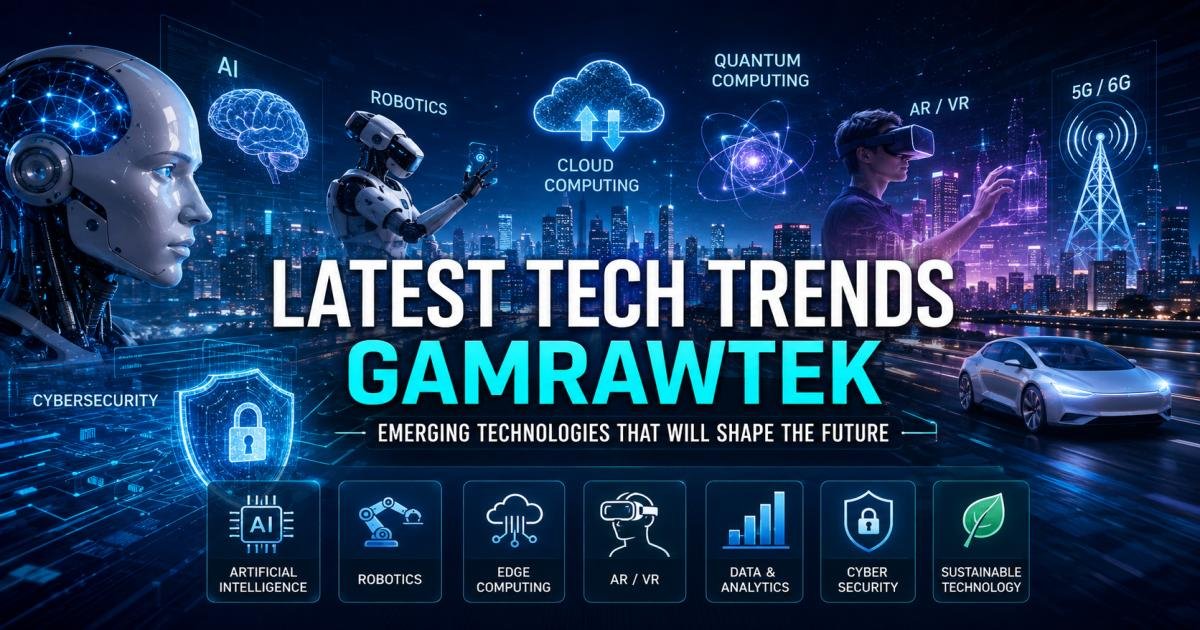

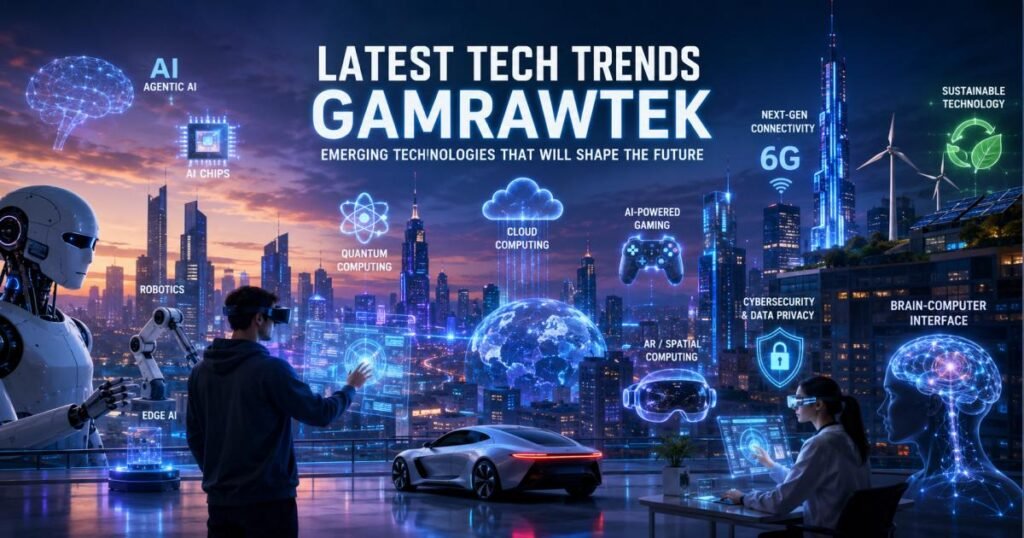
The latest tech trends Gamrawtek covers right now share one pattern: intelligence is leaving the cloud and moving into everyday objects. AI agents that act without step-by-step instructions, robots that grip and walk like people, glasses that layer a screen over the real world, and chips that run smart software with no internet connection at all — none of this is a future prediction. It is already shipping, being tested in real workplaces, and changing how people work, play, and stay connected this year.
The phrase “latest tech trends” has taken on different meanings over the years. A decade ago, it meant smartphones and social apps. This year, it means software that plans and acts on its own, machines that learn to move through physical spaces, and networks built to carry far more data than before. One data point captures the shift well: analysts tracking agentic AI project that by 2027, roughly 70% of multi-agent systems will use narrow, task-specific agents instead of one broad, general-purpose AI. That single number explains why so much of this year’s tech news centers on AI that does things, not just AI that answers questions.
This guide sorts the real from the speculative. It separates technologies with measurable adoption today from ideas still stuck in research labs, and it gives consumers, business leaders, developers, and gamers a clear picture of what actually matters right now. Below are the latest tech trends Gamrawtek and the broader tech industry are tracking closely.
What Are the Latest Tech Trends Gamrawtek Is Tracking?
From Gaming Innovation to Mainstream Technology
Gaming tends to test new technology before anyone else adopts it. Real-time graphics rendering, high-speed networking, and early AI behavior systems all appeared inside game engines years before they reached ordinary business software. That pattern continues. AI systems built to control lifelike game characters now power customer service chatbots. Graphics chips designed for rendering virtual worlds now train large AI models. Watching gaming hardware and software often shows what shows up in mainstream devices twelve to eighteen months later.
What Makes a Technology Trend Worth Watching?
Not every gadget announcement deserves attention. A trend earns a spot on this list when real users or companies already pay for it, the hardware or software has cleared its major technical hurdles, and a believable path exists from today’s version to a cheaper, wider version. Trends that fail these three tests usually turn out to be flashy conference demos that disappear within a year.
How This Guide Evaluates Emerging Technologies
Each technology below gets judged on three points: current maturity (shipping today or still experimental), near-term impact (what changes in the next year or two), and long-term potential (what it could become over the next five to ten years). This structure separates genuine progress from marketing claims.
12 Latest Tech Trends: Gamrawtek and Emerging Technologies to Watch
1. Agentic AI and Multi-Agent Systems
The biggest shift in AI this year is not a smarter chatbot. It is AI that takes action. Agentic AI systems read a goal, plan the steps to reach it, use software tools along the way, and adjust when conditions change, instead of only answering a question. Companies are moving away from one large, do-everything model and toward teams of smaller, specialized agents that pass tasks to each other, much like coworkers splitting up a project. That earlier stat bears repeating: roughly 70% of multi-agent systems are expected to run narrow, specialized agents by 2027, according to Gartner-based industry forecasts. Cybersecurity teams already use agent groups to triage alerts and take containment steps that used to sit in a human analyst’s queue.
2. AI-Native Software Development
Software development is being rebuilt around AI from the ground up. Coding assistants no longer just suggest a single line of code. They build entire features, write their own tests, and work for hours on one task without a developer checking in every few minutes. Developers still matter, but their role shifts from typing every line by hand to reviewing and directing what an AI-assisted workflow produces. Teams that redesign their process around this shift typically ship software faster than teams that simply add an AI tool to their old habits.
3. Physical AI and Intelligent Robotics
“Physical AI” describes robots that sense their surroundings and decide how to act, instead of following a fixed script. This technology drives both the current wave of humanoid robots and smarter warehouse machines. Progress is real but uneven. Industrial robots built for packaging and pallet stacking already run on factory floors. Two-legged humanoid robots still draw crowds at trade shows but remain several development cycles away from routine daily work. The honest picture in 2026 combines steady, narrow gains with real skepticism about how soon general-purpose humanoids become common.
4. AI Chips, NPUs, and AI Supercomputing
None of this AI progress works without specialized hardware. Neural Processing Units, or NPUs, are chips built to run AI calculations efficiently, and they now appear in laptops, phones, smartwatches, and even small industrial sensors. A built-in NPU is quickly becoming a standard buying factor for a new PC, the way processor speed or storage size used to be. At the same time, massive AI supercomputers packed with high-end chips still power the largest models, which creates two tiers: huge data-center AI for heavy computing, and small, efficient on-device AI for daily tasks.
5. Edge AI and the Next Generation of Connected Devices
Edge AI means running AI directly on a device, such as a phone, camera, or factory sensor, instead of sending data to a distant server first. This matters for three reasons. It runs faster, since there is no round trip to the cloud. It protects privacy better, since sensitive data can stay on the device. And it keeps working even without a strong internet connection. Cameras that recognize objects instantly, wearables that track health data in real time, and smart home devices that respond without delay all depend on this shift. As NPUs get cheaper, expect budget devices to carry real on-device intelligence too.
6. Quantum Computing Moves From Research Toward Practical Use
Quantum computing has sounded “five years away” for two decades, but 2026 marks a real turning point. Researchers have shown that adding more qubits can now reduce errors instead of increasing them, a milestone needed to build large, reliable quantum machines. Even so, fully fault-tolerant quantum computers built for everyday commercial work do not exist yet. Most real-world use today is hybrid: a quantum processor handles one narrow bottleneck inside a larger classical computing system. Pharmaceutical, finance, and logistics companies run early pilot projects, but broad practical impact typically sits closer to the end of the decade, based on current industry roadmaps.
7. AI-Powered Gaming and Next-Generation Gaming Hardware
Gaming keeps pushing graphics and AI forward together. Game worlds now use AI-generated content to fill in details that once required a full art team, and non-player characters hold more natural conversations than a scripted dialogue tree ever allowed. On the hardware side, cloud gaming has reached the point where a full PC game runs smoothly on a phone or tablet over a decent connection. Upscaling technology that boosts frame rates without hurting image quality has become standard rather than a rare feature. The same AI that generates a game character’s response already gets borrowed for other industries, including customer support.
8. AR, Spatial Computing, and Smart Glasses
Smart glasses have become one of the most successful new hardware categories in years. Lightweight glasses with a camera and voice assistant, without any display, have sold in the millions largely because people are willing to wear them all day. A second, smaller category of full augmented-reality glasses, built with a display that overlays digital content onto the real world, targets developers and early adopters who want a genuine spatial computing experience rather than just a voice assistant on their face. Bulkier headsets built for total immersion have cooled off by comparison, which suggests buyers prefer lightweight, all-day wearables over heavy, session-based devices.
9. Next-Generation Connectivity: Wi-Fi 7, 5G Evolution, and 6G
Wi-Fi 7 is rolling out fast, with shipments of compatible access points projected to grow from roughly 66.5 million units in 2025 to nearly 118 million units in 2026, according to ABI Research. It brings faster speeds and lets a device use multiple wireless bands at the same time for a steadier connection. On mobile networks, 5G keeps improving through new chipsets built around AI-optimized performance. 6G, the next major leap, still sits in the research and standards phase. Technical specifications are not expected for another couple of years, and a commercial rollout realistically lands closer to 2030. Right now, the practical connectivity story is about squeezing more out of Wi-Fi and 5G, not waiting on 6G.
10. Confidential Computing, Digital Provenance, and AI Security
As AI systems take on more independent tasks, keeping them secure and trustworthy has turned into its own technology category. Confidential computing protects sensitive data while it is actively being processed, not only while it sits in storage or moves across a network. Digital provenance tools help verify whether an image, video, or document is genuine or AI-generated, which matters more as synthetic media gets harder to spot. AI security teams also build dedicated tools to watch autonomous agents themselves, since a system that can take independent action needs guardrails, audit trails, and a reliable way to shut it down if something goes wrong.
11. Sustainable and Energy-Efficient Technology
AI growth carries a real energy cost, and the industry answers on two fronts. Chip makers design processors that deliver more computing power per watt, which matters for both data centers and battery-powered devices like phones and smart glasses. Data center operators invest more in efficient cooling and cleaner power sources to keep up with AI demand without letting energy costs or emissions spike. Efficiency, not just raw speed, is becoming a bigger selling point across chips and devices.
12. Brain-Computer Interfaces and Human-Computer Interaction
Brain-computer interfaces, or BCIs, have moved from science fiction into a small but real clinical setting. Companies including Neuralink and Synchron have implanted devices in a growing number of patients with severe paralysis, letting them control a computer cursor, play games, and browse the web using thought alone. The near-term focus for 2026 centers on scaling up production and making the surgery more automated and less invasive, rather than adding dramatic new abilities. This remains a medical technology first. Everyday, non-medical use of BCIs sits years away and raises real privacy and ethical questions the industry has only started to address.
How These Emerging Technologies Are Changing Everyday Life
Impact on Consumers
Consumers feel this shift through phones and laptops that handle AI tasks locally, glasses that summarize notifications or translate a conversation on the spot, and gaming devices that stream console-quality graphics from almost anywhere. The common thread is less waiting and less typing, with devices that respond in a more natural way.
Impact on Businesses
Businesses face pressure to move AI from a pilot project to a system that actually runs part of the operation, whether that means customer service, fraud detection, or logistics planning. Companies that redesign a workflow around AI agents typically get better results than companies that simply add a chatbot to an existing process.
Impact on Developers and Creators
Developers now spend more time directing and reviewing AI-generated code than typing every line by hand, and creators use AI tools to produce rough drafts of art, video, or game assets they then refine themselves. This shifts the valuable skill from raw production speed to judgment: knowing what works, what looks off, and what still needs a human hand.
Impact on Jobs and the Future of Work
Roles are shifting rather than disappearing outright. New jobs are forming around managing and auditing AI agents, and older roles increasingly expect comfort with AI-assisted tools as a baseline skill. The clearest advice for workers right now is to practice with these tools early, since familiarity with AI-assisted workflows is becoming a standard job requirement across many fields.
Which Latest Tech Trends Are Ready Now, and Which Are Still Emerging?
| Technology | Current Status | Near-Term Impact | Long-Term Potential |
|---|---|---|---|
| Agentic AI | Rapid adoption | Very high | Very high |
| AI-native development | Scaling | High | Very high |
| Physical AI and robotics | Emerging | High | Very high |
| Edge AI | Growing | High | High |
| Quantum computing | Early stage | Selective | Very high |
| AR and smart glasses | Emerging | Medium | High |
| 6G | Research and development | Low | Very high |
| Brain-computer interfaces | Early stage | Low | Potentially very high |
The Biggest Technology Trends That Could Shape the Next 5–10 Years
AI Becomes an Infrastructure Layer
AI is starting to resemble electricity or the internet: a background layer that other technologies plug into rather than a standalone product. Expect AI capability to become an assumed feature of software and devices, not a selling point people mention on its own.
Software Agents Become Digital Workers
As agentic AI matures and specialized agent teams become common, more organizations treat AI agents as digital team members with assigned tasks, performance tracking, and direct oversight, marking a genuine shift in how work gets structured.
Robots Become More Capable and Autonomous
Physical AI keeps narrowing the gap between scripted machines and genuinely adaptive robots. The realistic path forward is steady growth inside structured environments like warehouses and factories, while general-purpose home or humanoid robots arrive on a slower timeline.
Security and Trust Become Core Technology Requirements
As AI systems gain more independence, verifying what is real, auditing what an AI agent actually did, and securing systems against misuse become as important as the AI capability itself, not an afterthought added later.
Latest Tech Trends Gamrawtek: What Is Real and What Is Hype?
Technologies Already Showing Real-World Adoption
Agentic AI inside enterprise workflows, on-device AI chips in consumer electronics, Wi-Fi 7 networking gear, and industrial physical AI robots all get purchased and used today, not just demoed at a conference booth.
Technologies With Strong Potential but Major Obstacles
Humanoid robots, full AR display glasses, and hybrid quantum computing all show real promise but face genuine barriers: cost, battery life, dexterity, and error rates that typically take years, not months, to resolve.
Technologies That Are Still Mostly Speculative
Widespread 6G networks and non-medical brain-computer interfaces remain firmly inside the research or early-trial stage. Any claim of a consumer-ready version within the next year or two overstates the timeline.
How Readers Can Avoid Technology Hype
A simple filter helps here. Ask whether real customers pay for the product today. Check whether independent sources, not just the company’s own marketing, confirm the claims. Compare the promised timeline against how long similar technologies have historically taken to mature.
How to Prepare for the Latest Technology Trends
For Consumers
Choose devices with a built-in NPU if you plan to keep them for several years, since on-device AI features are becoming standard rather than optional. Treat flashy categories like humanoid robots and brain implants as things to watch, not things to buy yet.
For Businesses
Start with one well-defined, high-friction workflow for an AI agent pilot instead of attempting an organization-wide rollout at once. Build governance and oversight tools alongside the AI itself, not after problems show up.
For Developers and Technology Professionals
Build comfort with AI-assisted coding tools now, since reviewing and directing AI output is becoming as important as writing code from scratch. Pay attention to edge AI and on-device deployment skills, since more applications are moving away from cloud-only designs.
Risks and Challenges Behind Emerging Technologies
Privacy and Data Protection
Devices that constantly listen, watch, or read biological signals raise real questions about who can access that data and how long it gets stored. Smart glasses with always-on cameras and brain-computer interfaces sit at the sharpest edge of this concern.
Bias and Reliability
AI agents that make independent decisions can repeat and amplify errors or bias from their training data, especially when no human double-checks each step. Reliability testing needs to keep pace with how much independence these systems receive.
Energy Consumption
Training and running large AI models use a significant amount of electricity, and this growth puts real strain on power grids and data center capacity in some regions. Energy efficiency has become a genuine engineering priority, not a marketing talking point.
Digital Divide and Unequal Access
New devices such as AI PCs, smart glasses, and advanced medical implants typically launch at a premium price, which risks widening the gap between people and organizations that can afford early access and those that cannot.
Final Thoughts
Look closely at any one of these trends, and none of them stand alone. Better chips make edge AI possible. Edge AI makes smart glasses useful. Agentic AI needs security tools before anyone can trust it with real independence. Robotics needs both physical Artificial Intelligence and efficient hardware to become practical. The latest tech trends, Gamrawtek and the broader industry track this year, connect into one larger shift, where intelligence quietly becomes part of the everyday objects, networks, and devices people already use. Staying informed does not require chasing every headline. It requires knowing which of these pieces already work, and which ones still need more time to arrive.
FAQs
What are the latest tech trends Gamrawtek covers?
The current focus areas include agentic AI, physical AI and robotics, on-device AI chips, quantum computing progress, smart glasses and spatial computing, next-generation connectivity, and brain-computer interfaces.
What is the biggest technology trend in 2026?
Agentic AI, meaning AI systems that plan and take action instead of only answering questions, stands out as the biggest shift, based on how fast enterprise workflows have adopted it.
Is agentic AI the next major technology shift?
Yes, based on current adoption patterns. Cybersecurity and finance already run multi-agent AI systems for real operational tasks, not just experiments, and forecasts point to 70% of these systems using specialized agents by 2027.
How is AI changing gaming technology?
AI generates richer game worlds, gives non-player characters more natural behavior, and supports smoother cloud gaming and upscaling, which lets less powerful devices run demanding games well.
Is quantum computing ready for everyday use?
Not yet. Quantum computing in 2026 sits between lab breakthroughs and narrow, hybrid commercial pilots, with broad everyday use typically expected several years further out.
Will AI replace software developers?
Unlikely in the near term. AI changes what developers spend time on, shifting toward reviewing and directing output rather than typing every line, instead of eliminating the role outright.